
I’m still here I promise! After an absence of over two months I am back. I’ve done so much and had so much to write about over the past few months that instead of putting my head down and working on it, I just pushed it off, and with no “deadline” I was free to push it off indefinitely. But anyway, since there is so much to catch everyone up on, I am going to separate this out into a series of 3 posts over the next few weeks. The first post starting all the way back in the end of April and beginning of May when I took a road trip to Bruges, Belgium.
I started off the trip with a 6 hour drive after I got off of work, from Bremen to Bruges. I was able to drive through northern Germany, the Netherlands and the endless farms in Belgium. I arrived pretty late to my hostel which was a little outside of the city and decided not to do anything that first night. Instead, I did a little bit of research on what to actually do in Bruges as at that point I had no idea. I had seen photos of the city and knew how beautiful it was but besides that I had no idea what there really was to do there. After awhile, I gathered that most of the “to do” items in Bruges were located directly inside of the oldest part of the city, so that’s where I would spend my day.
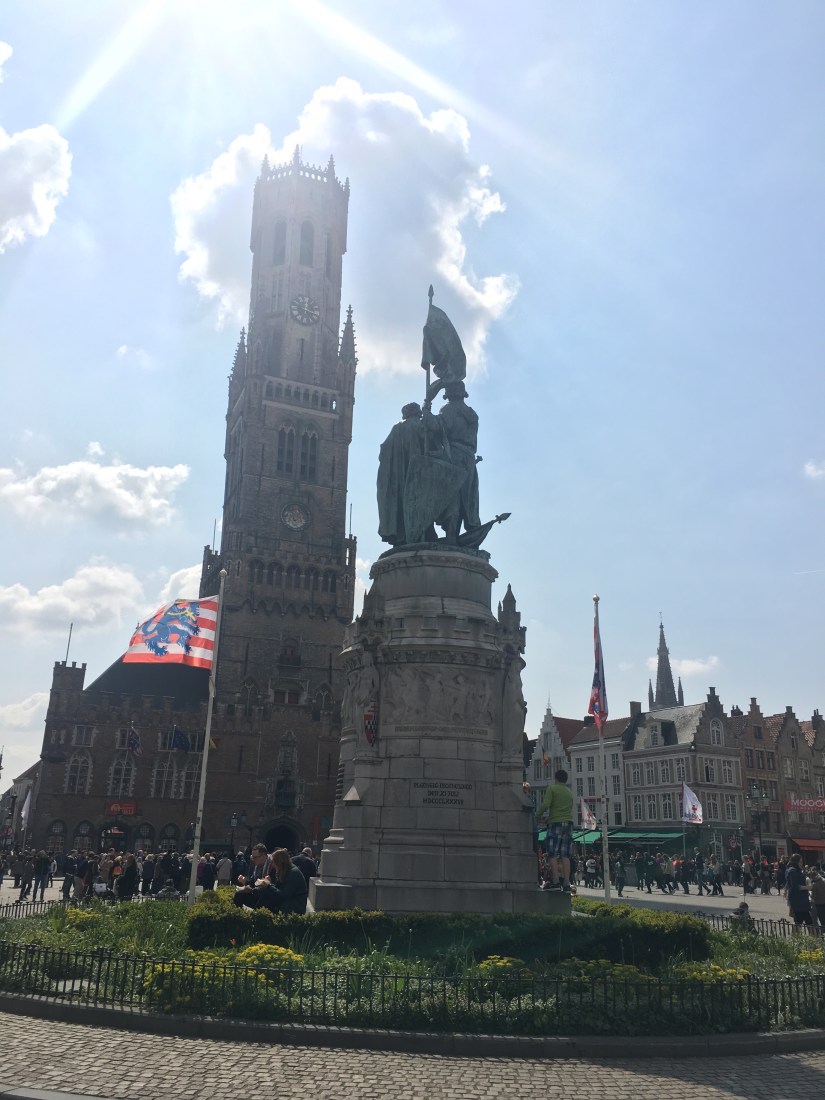
The “Belfry” in Bruges, Belgium
The old town of Bruges is one of the best kept examples of medieval architecture in Europe. The Belfort was built in 1240 and the town square around it has changed very little over the past few centuries. The canals that cut through Bruges only highlight this as it looks like there hasn’t been a single brick or cobblestone moved in centuries.
As I exited the winding narrow streets of the old town and entered the massive market square I wasn’t sure what to do first. But, as it was nearing lunch time, and I had walked by about 10 small cafes that all smelled amazing and seeing the patrons drinking massive “goblets” of beer I knew what my first stop would be. I found a small restaurant overlooking the main square and got myself a Duvel (one of the more popular Belgian beers). I looked over the menu and decided that I needed to eat local, but I couldn’t decide between the fresh mussels or Flemish rabbit. Luckily, there was another meal waiting for me that night that I could get the mussels at, so I ordered the flemish rabbit stew. It was the first time in my life that I had eaten rabbit so I wasn’t sure what to expect. All I could think of was the scene in Lord of the Rings where Sam is making rabbit stew for Frodo and Smeagle, and Smeagle is cursing him for being the “stupid fat hobbitses” for ruining the rabbits he caught for them. But, of course my stew turned out to be incredible, as well as my beer and it took all of my will power not to order a second bowl of stew with my second beer.
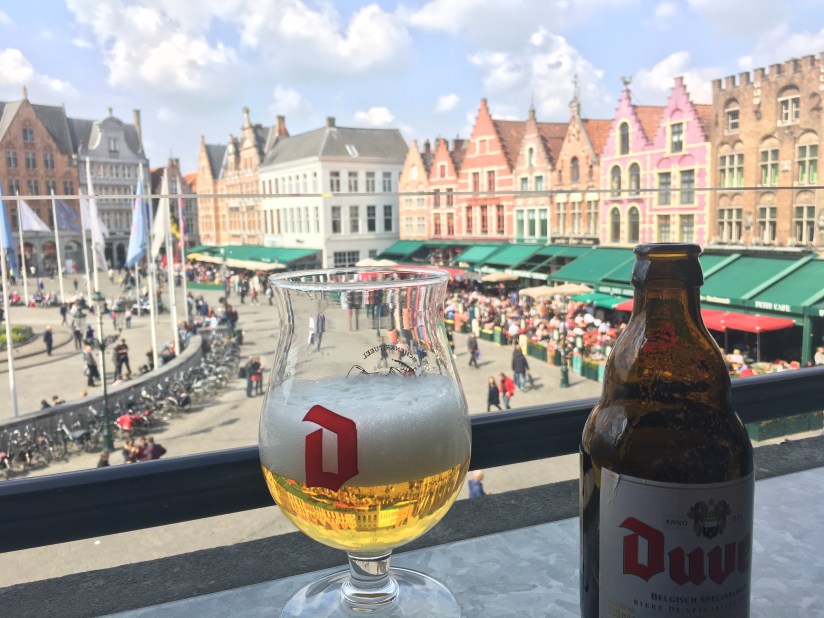
Duvel in Bruges Market Square
After lunch, I didn’t have much of a plan so I started walking, the old town wasn’t very large so I figured I could cover most of it in one day. I walked along the canals, explored the ancient Belfry, ducked into the Belgian chocolate shops and saw everything Bruges had to offer. The chocolate shops are literally around every corner. When I first arrived I didn’t have much of a plan to buy too much chocolate but after the 100th shop you don’t really have a choice and I bought a few chocolate covered strawberries to munch on.


Chocolate, chocolate and more chocolate
I was also able to go to the Basilica of the Holy Blood. The Basilica was built in the 12th century and it is a catholic church that contains a handkerchief from Thierry of Alsace that he had brought back during the second crusade in 1147 that he claimed was covered in the Holy blood of Jesus Christ.


Basilique du Saint-Sang or Basilica of the Holy Blood
I was also able to go and see Michelangelo’s Madonna of Bruges sculpture, which is his ONLY work to leave Italy during his lifetime. Since then, it has had a pretty interesting history. It has been forcefully removed from Bruges on two accounts. The first time, by French revolutionaries in 1794 and moved to Paris with a few other works of art, and the second time by Nazi’s in 1944 on their retreat back into Germany. The sculpture was first returned to Bruges in 1815 after Napoleon’s defeat at Waterloo, and the after its second kidnapping it was discovered in a salt mine in Altaussee, Austria, and it’s recovery was a key feature in the motion picture “Monuments Men.”
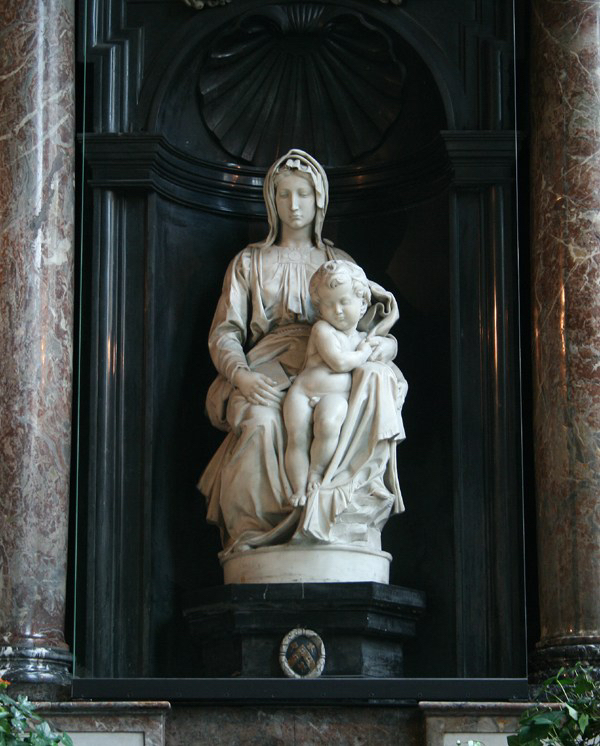
Photography of the work wasn’t allowed, but here is a picture from google… Sorry haha
But back to Bruges again, the city was truly fascinating and at times you could lose the crowds in the back alleys of this town and it felt as though you were stepping back in time, no cars, no streetlights, old painted wooden shop signs and the cobblestone streets all made it feel as though it were the mid 1000’s, in the golden age of Bruges, just a tiny bit cleaner and healthier.
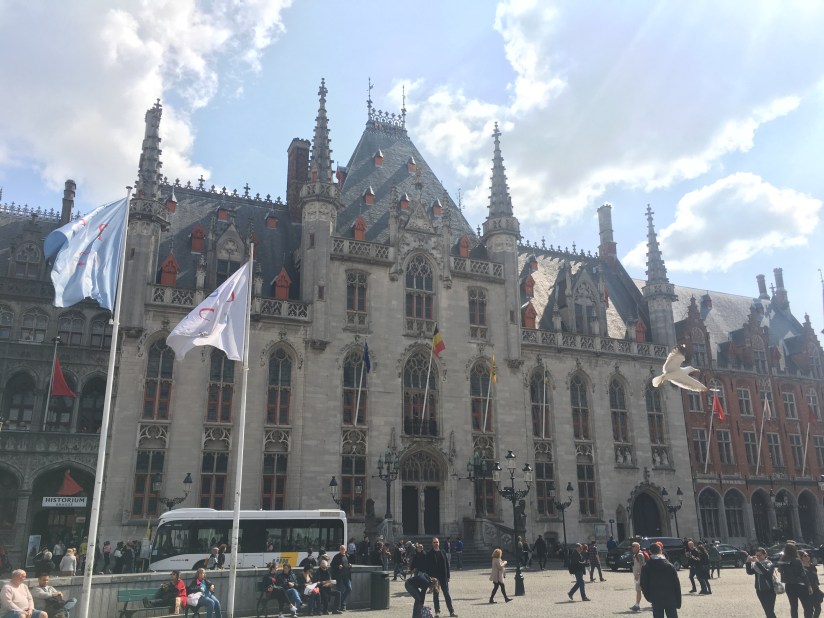
But after a few hours of wandering and exploring and trying to make room in my stomach for my afternoon snack I knew that it was finally time for my waffle. I had been waiting on this ever since I decided to travel to Belgium and the time had finally come. I walked up to the first waffle shop I could smell and as I was about to get in line… about 20 kids from a field trip got in front of me… Oh how I watched in pain as all of the strawberries and fresh toppings slowly disappeared in front of my eyes onto their ungrateful waffles. But with about 1 child left in front of me the most amazing thing in the world happened. A Belgian girl came out from the back of the shop with a bushel of fresh strawberries and a bowl of fresh whipped cream and began slicing the strawberries right in front of me. All of the kids I guess were a blessing in disguise as they ate all of the ingredients that had been sitting out and got the waffles that had been made previously. Everything on my “just-made” waffle was fresh and new and boy was the wait worth it. I practically speed walked to a bench in the main square and scarfed down my waffle in about 10 seconds… But not before an old eastern Asian lady walked right up in front of me to take my photo. I probably had chocolate sauce all over my face but I didn’t regret a second of it.
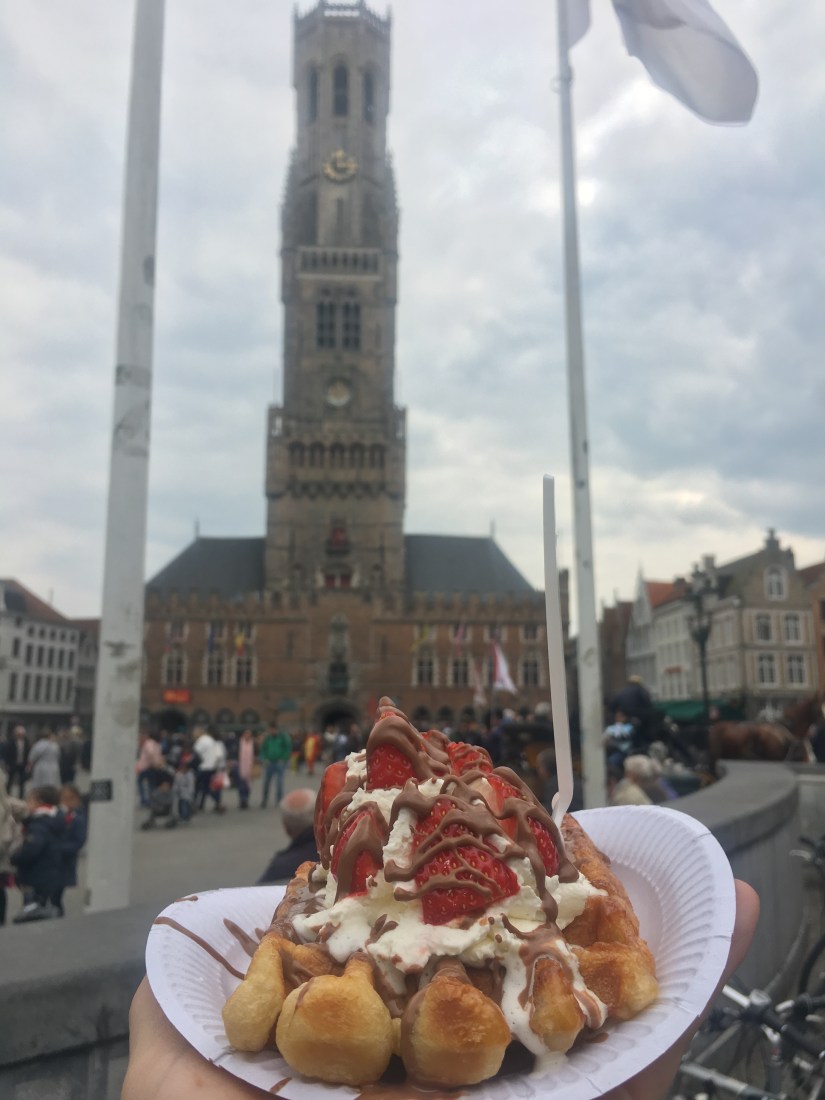
Could arguably be the best part of the day…
After this, I returned to my hostel for a quick break before heading back to the square for dinner and another great Belgian beer. I had the mussels that had been on my mind ever since lunch and while they were fantastic and delicious, they didn’t leave the lasting impression on me as the rabbit did. Following dinner I went for another walk as the weather was beautiful and the town was almost entirely empty of tourists. The views were incredible and I could have stayed there for hours, but I had plans bright and early in the morning and needed to call it a night.
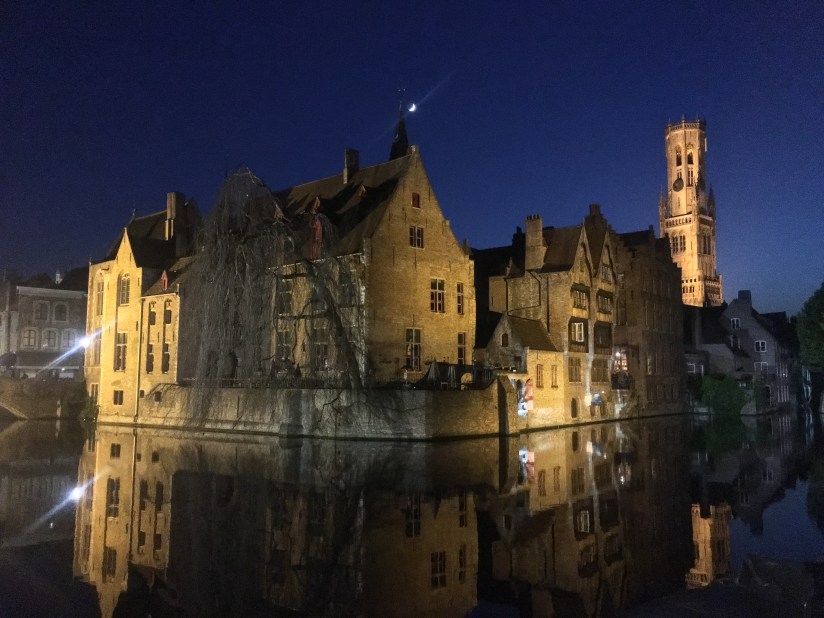
Bruges at night..
The next morning a woke up at 7 and began my drive south into France. I realised in Bruges that I was actually only a short drive away from some of the worst fighting of the Great War (World War 1), and I was only about an hour and a half away from Vimy Ridge. As a history major in university studying World War 1, we focused on other battles, such as the Marne, and the Somme. But as a Canadian doing my own research, I read all about Vimy Ridge, and how influential the battle was on the Canadian identity not to mention how technologically advanced the battle was at the time as well. In fact, Vimy Ridge was the first time in history, that a former colony had defeated one of the great European powers on European soil in battle, ever. And it was done by the Canadians in April 1917. Exactly 100 years ago.

Vimy Ridge Battlefield and Memorial
The battle itself showed the true character of the Canadian military. For the first time, all four Canadian divisions were assembled on one battlefield, fighting as one. The plan of attack was to utilise a tactic that was still in it’s infancy and one that had not seen high levels of success yet. The idea was that artillery would fire for 30 minutes, then adjust their aim forward 100 yards, fire for 30 minutes, adjust aim forward 100 yards and so on and so forth, slowly creeping onward. All the while, the Canadian troops would be advancing as close as possible to the landing shells, using them as cover.
With modern military technology and computers this sounds somewhat simple, but without gps, or wireless communication this all came down to human judgement and timing. The troops in charge of the artillery had to keep an eye on the clock and their aim or risk firing on their own troops and the infantry advancing knew that if they allowed the artillery to get too far ahead of them that they would be sitting ducks for the German machine guns, yet if they advanced too rapidly they would fall victim to their own artillery leading the attack. Once the attack began there was no stopping it, no pausing or readjusting it all depended on meticulous timing, precision and preparation from all 4 divisions. The time was now and when the first troops went up and over the side of the wall they knew they would either end the battle in command of the German stronghold on Vimy Ridge or laying face down in no mans’ land.

View of the Memorial with the still scarred terrain.
As fate would have it, the plan worked brilliantly, and over the course of 4 days the Canadians had not only pushed the Germans from the Ridge but also the surrounding high grounds, as well as capturing invaluable German artillery pieces and freeing the few French towns that were just beyond the ridge. The battle still stands as a great feat of arms, technology and teamwork and became incredibly important in the development of Canada’s national identity. No longer were the soldiers looked on as part of the British military, like the Australians, South Africans and Indians. They were now Canadians, and they could hold their own on the global stage.
Vimy Ridge was the first major victory for the Canadian Corps as a group, that helped them gain more experience, and momentum leading them on for the next year, climaxing in a stretch from August 1918 to November 1918 known as “Canada’s 100 Days.” During this stretch the Canadian Corps, which consisted of 4 divisions of a total of roughly 100,000 men claimed victories in the Battle of Amiens, 2nd Battle of the Somme, Battle of the Scarpe, Battle of the Canal du Nord, Battle of Cambrai, Battle of the Selle, Battle of Valenciennes, and Mons before the Armistice of November 11th was signed. In total the 4 Canadian “heavy divisions” engaged and defeated 47 German divisions. After which Canadian troops garnered the reputation for being one of the toughest, most well-trained fighting forces in the world.


Artillery craters still dominate the landscape
But all of this did not come without a cost, and the Vimy memorial reminds us of that. On the backside of the limestone monument there are 11,285 names and ranks of the Canadians that died or went missing in France during the Great War and whose graves are unknown. All now, under the watchful eye of the personification of Canada, mourning her dead.
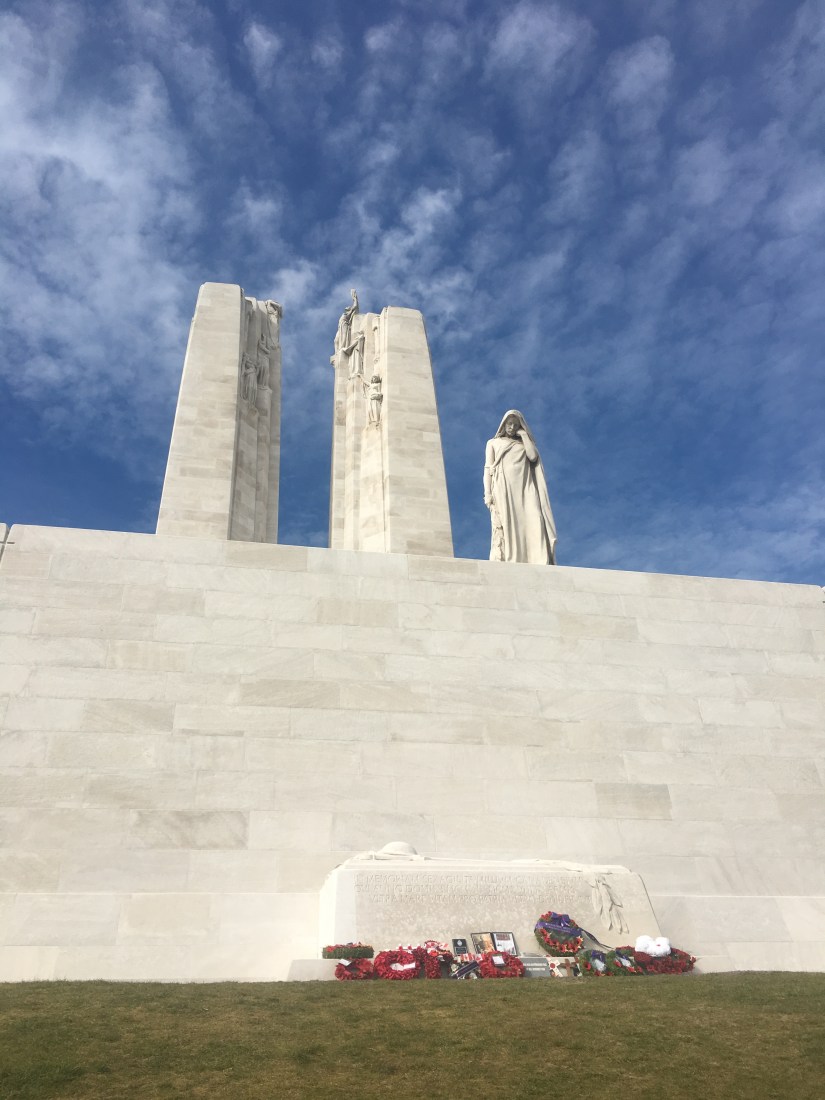
“Canada” mourning her dead
At first when I arrived, and saw this monument, the names of the dead and missing, the pockmarked fields and warning signs, and the final resting places of so many Canadians, so far from their homes. I was saddened by the fact that the park was so empty. More people need to see this place and learn what happened here. But the reality of the situation is that, a lot of people will never get a chance to come here. It’s not easy to access and for the average Canadian, the trip to France and Vimy Ridge is not possible. So for the 11,285 names etched on the monument, most will never know their names or their stories, and their sacrifices will fade into history and all that will be left is a name and rank engraved into the limestone.
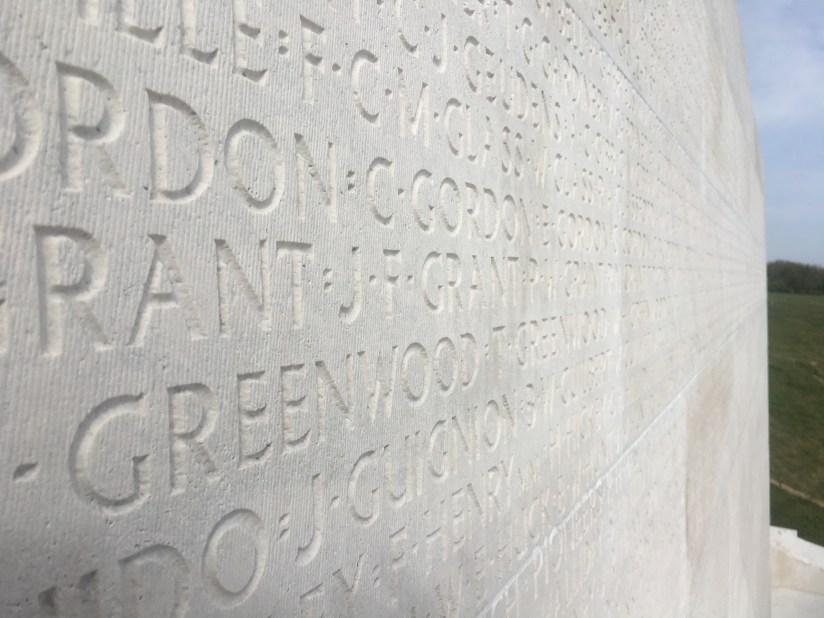
A few hours later as I got in my car, preparing myself for the long drive back to Bremen, I had time to think about what I had just witnessed. A small part of me wished that these troops could be moved back to Canada so that their sacrifice could be appreciated properly but that is just not possible. And while the park was well kept and diligently taken care of, I felt like the entire area existed in it’s own bubble and as soon as I were to leave that, the world would go on not knowing what happened here or who made it all possible.
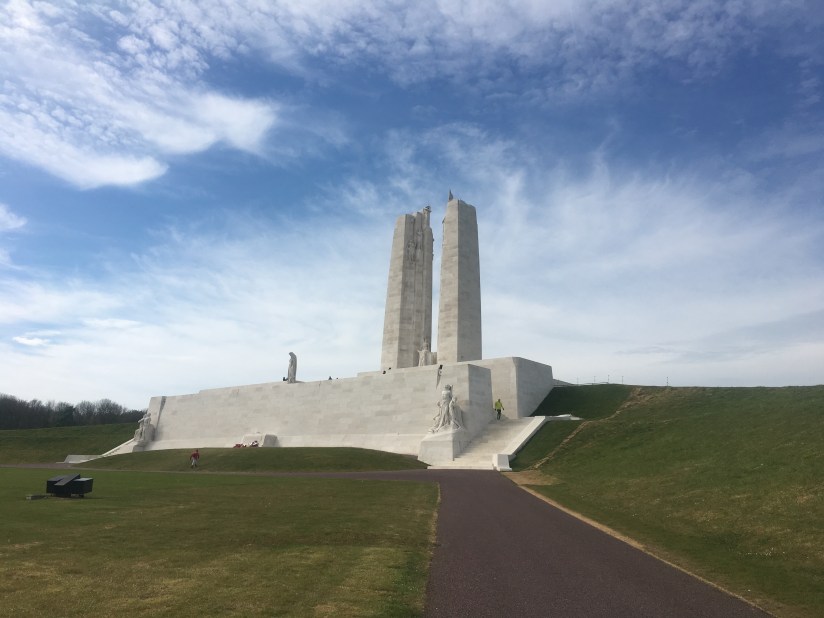
But as I entered the first town just east of the Ridge, I realised I could not have been more wrong. The small town would have been one of, if not the first town that Canadian troops freed from the Germans during the battle. And as I drove up I saw something I did not expect.. a Canadian flag.
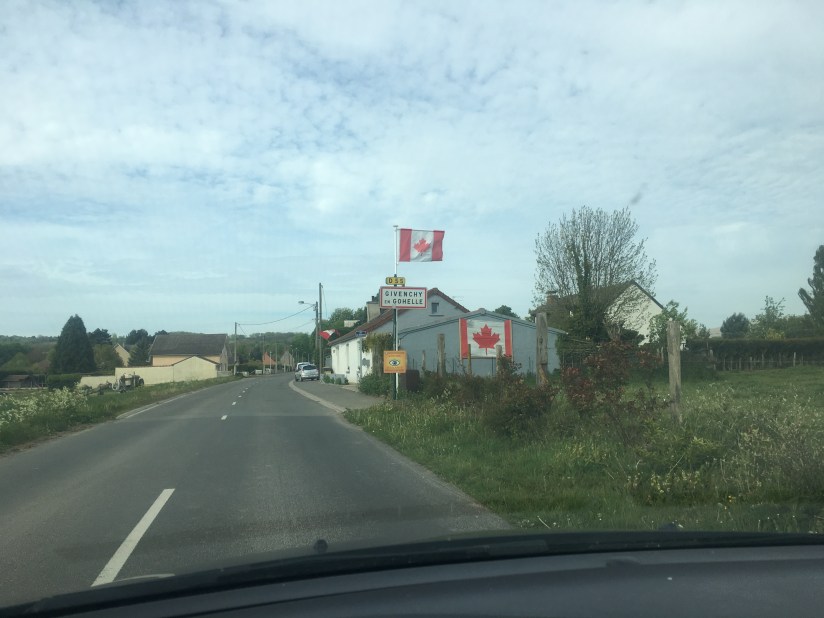
Then, as I came around a corner, I saw another one, and then another, and then another. On flag poles, on decks and hanging from windows, almost every home had a Canadian flag displayed somewhere or somehow. It became very clear to me that the monument and park didn’t just exist in it’s own little bubble, here was a town, that after 100 years, still hadn’t forgotten the sacrifice of the Canadian troops and it was obvious what that meant to them.


I stopped and got out of my car at one point and turned, wondering if I could see the ridge from here. Not only, was it plainly visible from the town, but the monument could be seen prominently on the ridge, clearly visible for miles across the flat landscape. It was nice to know that, even if history will forget their names, their actions won’t be forgotten anytime soon in this small region of France.
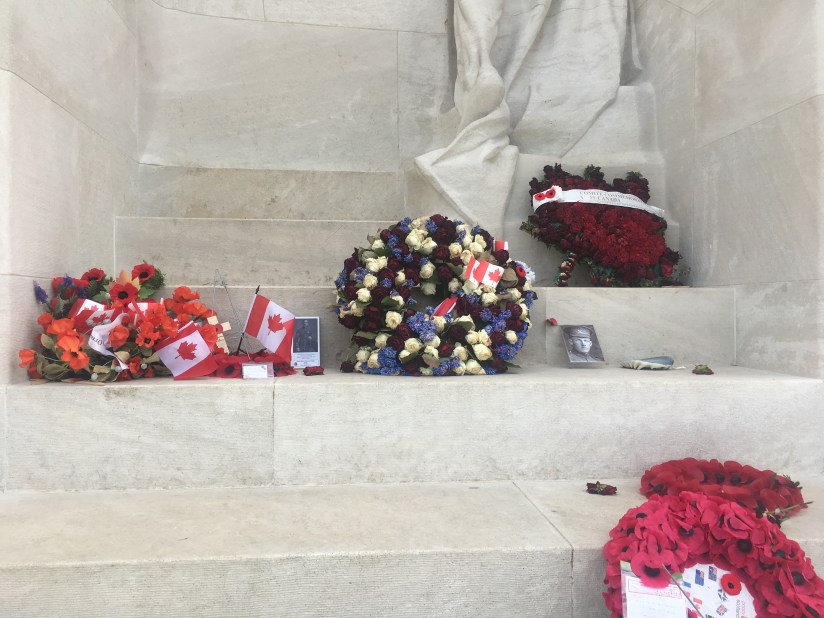
“Lest we forget“
I’m gonna leave this section and you here for now with the poem “In Flanders Fields” by Canadian soldier, John McCrae, although the poem was written during the 2nd Battle of Ypres in Belgium, I saw it quoted in and around the Vimy Ridge memorial on postcards and photographs. Expect the next part of my travels to be posted soon, auf Wiedersehen.
“In Flanders Fields”
In Flanders fields the poppies blow
Between the crosses, row on row,
That mark our place; and in the sky
The larks, still bravely singing, fly
Scarce heard amid the guns below.
We are the Dead. Short days ago
We lived, felt dawn, saw sunset glow,
Loved and were loved, and now we lie
In Flanders fields.
Take up our quarrel with the foe:
To you from failing hands we throw
The torch; be yours to hold it high.
If ye break faith with us who die
We shall not sleep, though poppies grow
In Flanders fields.


 My new life in northern Germany
So glad you’re back to writing! Another wonderfully written account of an important time in history. Love ya Vince. Xo
Sent from my iPhone
>
LikeLike
Well written Vince and I enjoyed the read very much on this Sunday morning. For some time, I have been planning a trip along the coast where the Vimy Ridge Memorial and battlefield is and ensure we get to see and understand better the sacrifice made by Canadians here. Your post has now inspired me enough to make sure this happens within the next couple of years. I have always been told or read about the appreciation shown by many of the towns/villages in the region as it relates to the Canadian efforts through those times. Also, need to get back to Belgium as Bruges is one spot we have not had the chance to visit ….. waffles, whipped cream and strawberries along with a Duvel or Leffe Brun! What more could you want! Thanks again for the post and I look forward to the next one! Uncle Dan
LikeLike
So interesting! Made me so proud to be Canadian . Brought tears to my eyes. Thanks, Vince,
for this gift for our 150th anniversary. Love, Auntie Thea xox
LikeLike
So proud that you focused on the lives of eleven thousand young men who fought for the freedom of strangers in a foreign land. And this is just a tiny portion of the many others who fought and died for our freedom, that we should cherish and protect.
Congrats on conquering escargot and rabbit. A sure sign of your heritage – Italian love of great food and British fortitude. Love you and God bless.
Dad
LikeLiked by 1 person
Thank you Vince for your spirited, heartfelt and informative post. I appreciated your history lesson.
Love & miss you LOTS, Moonshine!
Love Auntie Fran xoxoxo
LikeLike
Vince, thanks for sharing this. I have tears in my eyes…you are so eloquent! It is a poignant reminder that Canadians are respected and loved in so many countries! What a wonderful blog entry, especially right after the 150th Birthday celebrations here in Canada. So proud to be Canadian, and so proud of you. xoxo
LikeLike